Removals to Germany in Germany

Removals to Germany in Germany are handled best when the plan is clear, the inventory is accurate and the transport method suits the load. We arrange household and business moves with a practical focus on loading, transit and delivery, so the work stays organised from the first packed box to the final placement of furniture. If you are planning a cross-border move, the most useful starting point is a straightforward discussion of what needs moving and when.
Our removal service can cover single rooms, full properties, office contents and mixed loads that need careful sorting before departure. Where items need disassembly, wrapping or staged loading, we can work through the sequence in a way that keeps the move manageable. The aim is simple: provide a structured removal plan that reflects the volume, access and delivery point rather than forcing every job into the same pattern.
For a quotation, it helps to have a clear list of the items involved and the collection and delivery details ready to share. You can request pricing once you know the broad dates and the type of property at each end. If you are comparing options, take a moment to review the service scope and the practical support available before you make contact.
Household removals and move planning
Household removals to Germany often need a different approach from a local move because the route, timing and load preparation all have to work together. We handle domestic moves that may include everyday furniture, boxed belongings, kitchen contents, personal effects and items that need careful securing for the journey. Clear labelling, sensible packing and a realistic loading order help reduce delays on the day and make delivery easier to manage.
When a household move involves several rooms or a larger property, it usually pays to separate the work into stages. Heavy furniture can be prepared first, followed by fragile household items and then loose pieces that are easy to misplace. A good move plan also considers access, parking, upper floors and any restrictions at the delivery point. That is where concise information and good timing make a real difference.
To keep things practical, have these details ready before you ask for a quote:
- the collection and delivery postcodes
- the type of property at both ends
- a rough list of furniture and boxes
- any stairs, lifts or tight access points
- items that need dismantling or special handling
Commercial removals and office relocation

Commercial moves need planning that respects business continuity as well as the physical load. We support office relocation work that may include desks, chairs, cabinets, IT equipment, archive boxes and reception furnishings. A sensible commercial removal plan gives priority to label-led loading, secure transport and a delivery order that suits the new layout. It also helps when departments, floors or work zones are being moved in a specific sequence.
For businesses, the main decisions are usually about timing, access and the handling of equipment. A small office may move in one organised load, while a larger workplace may need a phased approach that keeps essential items separate from general furniture. If specialist packing is required for sensitive items, it is better to identify that early rather than leave it to the day of the move. Office removals can then be matched to the actual scale and layout of the job.
Quotes for commercial removals are clearer when the scope is set out by area or department, because that shows how much sorting is involved. If you need help with a business move, keep your notes concise but specific: quantity, access, floor level and whether anything is especially heavy, fragile or awkward. You can ask for a quotation once those points are ready, and a well-prepared enquiry usually makes the planning easier for everyone.
Packing support and item protection
Packing is often the difference between a move that feels controlled and one that becomes stressful. Our packing and unpacking services are designed to support the removal itself, not replace it, so the emphasis stays on protecting the contents and keeping the load easy to manage. Boxes, wrap, protective materials and careful grouping all help when items are travelling a long distance or passing through more than one handling stage.
Fragile belongings need especially sensible treatment. Glassware, ornaments, lamps, artwork and small electrical items are usually safer when they are packed by category and marked clearly. Large furniture can also need protection at corners, feet and surfaces before loading begins. If you are arranging a cross-border move, packing and unpacking services may be useful where time is limited or where you would rather reduce the amount of preparation you need to do yourself.
Good packing choices are not only about protection; they also make unloading faster and less confusing at the destination. Items packed by room and by use are simpler to place where they belong, especially when a property is not fully furnished yet. That is why we recommend keeping a clear list of fragile pieces and a separate note of anything that should be opened first.
Loading methods and vehicle options
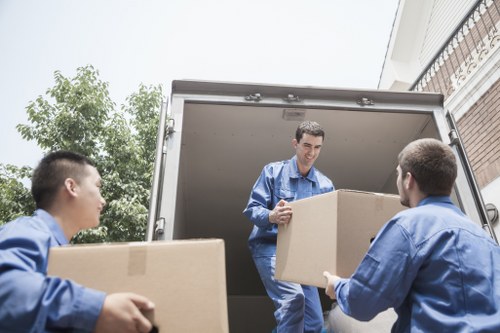
The transport method should fit the move, not the other way round. Depending on the load, a van-based service, a larger removal vehicle or a combined approach may suit the journey better. The main aim is to keep the cargo secure, avoid wasted space and make sure that the sequence of loading works with the access at each property. Careful use of straps, blankets and sensible stacking helps preserve both space and condition.
Smaller moves may be handled with a compact load plan, while larger household or office moves benefit from a more structured split between furniture and boxed goods. If you are comparing vehicle options, it is useful to think about the balance between volume, weight and the shape of the items. Moving van and moving truck pages can help you consider the general transport format that best suits your move.
Some customers only need a straightforward collection and delivery service, while others need help preparing the load before it can safely travel. Either way, the vehicle choice should reflect the job honestly. That means looking beyond the headline item count and thinking about awkward pieces, walking distance, stair access and the likely order in which the goods will come off at the destination.
Man and van removals for smaller loads
For lighter or more compact moves, a man and van removals service can be a practical choice. It is often suited to partial house moves, a few key pieces of furniture, student loads, storage transfers or mixed items that do not need a large lorry. The work still benefits from proper planning, because a small load can be surprisingly awkward if it includes awkward shapes, fragile items or multiple drop-off points.
Where the move is limited in size but still requires careful handling, flexibility matters more than scale. Items may need to be moved from a flat, a house or an office and delivered in a way that keeps the load balanced during transit. If you want to look at the available format, man and van removals and man with van provide a sensible starting point for a more compact removal plan.
Smaller moves can be efficient when they are prepared properly, but they are not necessarily simple. An item of furniture that will not fit through a doorway, or a stack of boxes that needs reordering for safe travel, can still take time. The clearest quotations are based on what is actually being moved, not on a broad assumption that every small job is quick.
Furniture pick-up and single-item transport

Furniture pick-up work is useful when you only need selected items moved rather than an entire property cleared. It may involve sofas, beds, wardrobes, tables, office desks or combinations of furniture that need careful loading and securing. The practical questions are usually whether the items can be moved as they stand, whether they need to be dismantled, and how much room they will take once they are prepared for transit.
Single-item transport still benefits from a methodical approach. Heavy or oversized pieces can damage walls and door frames if they are moved without planning, while delicate finishes may need padding and support before the vehicle is loaded. Furniture pick-up is therefore best considered as part of the wider removals service, especially where one or two items are being relocated across a longer distance.
If your move includes only furniture, it can be helpful to note the dimensions or at least the type of item and the access at each end. That allows the load plan to be realistic from the start. It also means the quotation can reflect the actual handling required rather than assuming that every piece can be carried and stacked in the same way.
Pricing factors and quote preparation
Quotation work for removals to Germany is usually shaped by a small number of practical factors: the amount of property being moved, the access at both addresses, the kind of items involved and the distance between collection and delivery. Additional handling for packing, dismantling or larger furniture may also affect the scope. A clear quote should reflect the real workload rather than offering a vague price that leaves too much uncertain.
If you are comparing providers, look at the service scope alongside the headline cost. Some jobs need transport only; others need more hands-on support with sorting, wrapping or loading. It is also sensible to note whether the move is residential, commercial or a mixture of both, because that changes the planning. Pricing and quotes gives a useful route into the commercial side of the service if you want to understand how an estimate is prepared.
Useful quote notes usually include the main items, the floor levels, parking distance, any lifting restrictions and the preferred date range. You do not need to write a long message, but you do need enough detail for the move to be assessed properly. A concise enquiry makes it easier to confirm what is included and what should be added separately.
Insurance, handling and safety

Good removals work depends on safe handling, sensible loading and clear responsibility for the items being moved. Cross-border transport places extra importance on protection because the journey is longer and the goods may be handled more than once. The value of the load is not the only consideration; shape, fragility and weight can matter just as much when deciding how to wrap, stack and secure each item.
We also recognise that customers want to understand how safety and protection fit into the moving process. Insurance and safety and the related health and safety information provide a useful reference point when you are planning the move. That matters most where there are large items, tight access routes, shared buildings or delicate possessions that need careful treatment from collection to delivery.
Before you request a quotation, it is worth checking whether any items need to be separated, protected or dismantled in advance. That does not mean overpacking everything; it simply means avoiding surprises on the day. A practical removals plan should support the move itself, keep the load secure and reduce the chance of avoidable delay.
About Germany
Germany lies in central Europe and shares land borders with nine countries, making it one of the continent’s most connected states. It has coastlines on the North Sea and the Baltic Sea, as well as major river systems including the Rhine, Danube, Elbe and Main, which have long shaped settlement, trade and industry. The modern federal republic was established in 1949, and since reunification in 1990 it has combined major urban centres, historic towns and wide rural regions within one political framework. Berlin is the capital and also a city known for its layered history, from Prussian and imperial periods to Cold War division and reunification-era development.
The country’s cultural geography is varied. Northern areas are marked by flat lowlands, ports and maritime influences, while the south rises toward the Bavarian Alps and the uplands of Baden-Württemberg. Many cities preserve compact historic cores with churches, market squares and civic buildings, often rebuilt or restored after wartime damage. Cologne Cathedral, the Brandenburg Gate, the Semperoper in Dresden and the Residenz in Munich are among the best-known landmarks, while smaller towns may be recognised for timber-framed streets, spa traditions or medieval walls. Germany also has a strong museum and theatre culture, with institutions such as the Museum Island complex in Berlin and the Pinakothek galleries in Munich reflecting the country’s long artistic and intellectual life. Seasonal customs, regional dialects and local food traditions vary noticeably between states, adding to the country’s sense of distinct local identity even within a shared national structure.
Beyond the main cities, Germany includes forests, lakes, vineyards and protected landscapes that shape both leisure and working life. The Black Forest, the Bavarian Forest and parts of the Rhine valley are especially well known, while the country’s transport network links many regions through rail, road and inland waterways. That combination of historic depth, modern infrastructure and regional variety makes Germany a place of strong contrasts, from dense metropolitan districts to quieter areas shaped by agriculture, tourism and long-established craft traditions.
Additional removal support
Some moves need a wider support package than transport alone. That may include staging the load, grouping items by room, removing disassembled furniture from the property and ensuring that everything is ready for onward delivery. When the move includes more than one type of property or a mix of household and business items, the most helpful approach is usually to keep the plan organised by category rather than trying to treat every item in the same way.
Our removal pages cover several related service types, including house removals, commercial moves and office relocation services. That range gives customers a clearer way to match the job to the right kind of support, whether the priority is domestic furniture, business equipment or a combined move with multiple tasks. The more closely the service matches the actual job, the easier it is to manage the route and the delivery.
If you are ready to move ahead, you can ask for a quotation in plain terms: say what is moving, where it is going and whether anything needs extra care. The final step is simply to request a quote once the details are clear. That is usually the quickest way to make sure the service is shaped around the move rather than the other way round.